










website security: What the Padlock Actually Means
The padlock means the page was encrypted in transit. It does not vouch for the business, and it does not mean the site cannot be broken into.
Web Design, E-Commerce & AI Innovation Studio
Idea Forge Studios is the studio's official publishing identity for articles on web design, e-commerce, AI innovation, and digital marketing.
The padlock means the page was encrypted in transit. It does not vouch for the business, and it does not mean the site cannot be broken into.

There is no fixed number of city pages a small business website needs. Match each page to a real shop, crew, or offer, and do not copy a page and only change the city name.

On a phone, Core Web Vitals are a slow first screen, a laggy tap, and a page that jumps. Each one times a wait a customer can feel, and a good report is not a top ranking or a lead.

A small team can design the site, host it, and keep the search work on one monthly price. For the owner, that means fewer bills and fewer handoffs, not a promised ranking or lead count.

The first month of a WordPress to custom site migration is checks, not a result. Point each old URL at the matching new page, confirm the form still receives an inquiry, and carry the structured data that names the business.

A small business can use Google Flow and Veo 3.1 for AI video marketing when the job is a short clip and a person still decides whether it looks like the real business. Four, six, or eight seconds is not a finished commercial by itself.

Shopify store design fits when you want a hosted shop that lists products, tracks inventory, and takes payment at checkout. WooCommerce fits a WordPress site you already run, and a quote catalog fits when the buyer logs in, sees a tier price, and sends a request instead of paying on the site.

A small business website keeps costing money after launch. The cost is a set of jobs that return, not one figure.

A site from our custom website development work can be updated as one coordinated change, with your OK, when the web changes. We do not promise a better score, a higher ranking, more leads, or a deadline.

WCAG 2.2 is the W3C Recommendation for making web content more accessible. Three Level AA additions cover target size, focus that is not fully hidden, and a login that is not only a memory test.

A client portal should show the written record of asks and edits, posts you can review before they go live, and the auto-publishing switch. Core pages stay reviewed, and WordPress is the better fit if you want to edit every page yourself.

You do not need an llms.txt file for Google's AI Overviews or AI Mode. Google Search does not use the file, and eligibility still depends on an indexed page that can show a snippet.

We scope a custom web application by writing the workflow down and quoting the lift, including hardware. A no usually hits a closed API, a middleman, or a privacy rule.

You can tell which ad channel brings the lead only after lead tracking is in place. Your cost per lead is that channel's spend divided by the leads you defined, and no channel wins in general.

Managed website hosting, as practiced here, runs one site per container with custom-coded pages served through Cloudflare. A backup is a copy you can restore from, not instant recovery.

We show a sent confirmation only after the lead and a delivery record are saved. If the handoff does not finish, we retry delivery of that saved lead instead of asking the visitor to submit again.

A template builder still fits a simple brochure you want to edit yourself, when the pages sit inside the blocks it already provides. A Wix alternative fits when the business needs pages or a workflow those blocks cannot express, and you would rather we carry the site.

When a logo should move, use a short animated logo that plays once as WebP and stops on a still frame. Show that still frame when the device is set to reduce motion, and do not put a GIF in the header.

We keep a site on WordPress when a WooCommerce store and the people who edit still fit it. We move when the public site is a few pages and unused plugins, builders, and shortcodes are the upkeep.

When a model reads inbound mail, a support ticket, or a PDF, a sentence in that material can be treated as an order. Keep the real job in instructions that text cannot change, and have a person approve any send, payment, or record change.

A free-text reply is not a CRM row or a ticket. Structured outputs for AI workflows can require a JSON schema, but nothing is written until your app accepts that schema and the business rules.

For companies already on Microsoft 365, choose Power Automate when a prebuilt connector and a single prompt can finish the text. Use n8n for the model call when the model must choose tools, a named deployment is required, or that call should run on infrastructure you operate.

After go-live, AI workflow ownership is a named roster, not a shared inbox. One person gets the failure, one may change a prompt or approve a customer-facing send, and one can stop the spend.

AI workflow release control is a small set of habits for a live automation: test the change on a saved fixture, let a named person publish it, and keep a last known-good copy you can put back without running earlier writes again. Saving an edit is not the same as publishing it.

AI finance exception ownership means a named person, not the software, owns the exception queue, the reversal, and the audit trail when an agent proposes an invoice, a bill, or a journal line. The agent may draft, and the bookkeeper and the owner still sign.

For a small operations team, RAG for operations knowledge means answers come from this week's SOP, ticket, and policy. A fine-tune writes a snapshot into the weights that stays when the procedure changes.

LLM cost control is four rules on a workflow you already run: a token ceiling for each item, a cache for the prefix that does not change, a smaller model for the easy step, and a stop when the run costs more than the labor it replaces. A small operations team can enforce the four rules on the queue it has today.

Before an AI workflow calls a hosted model, classify every field as public, internal, confidential, or regulated, then treat the whole payload at the strictest label. Public can use a standard API; internal needs a paid no-training path; confidential and regulated stay private, get redacted, or are refused.

Once AI agents are in production, quality is a measurement problem. Use a golden set from real cases, pair offline evals with live sampling, and staff a quality SLA.

n8n workflows fail when an API rate-limits you, a CRM write succeeds then errors, or a later node fails after earlier writes already landed. Pair Retry On Fail, an Error Workflow, and idempotent writes so a failed run can be replayed without duplicating records.

Keep n8n or Make as the default for known sequences. Buy custom AI solutions when four tests fail: versioned policy, an audit trail that outlives the canvas, writes that cannot run twice, or data that must stay off a third-party host.

AI chatbots for operations are internal assistants in Slack, Microsoft Teams, or a staff desk that read and write CRM and tickets through tool calls. The model proposes a function; your application checks identity, makes writes retry-safe, and sends irreversible actions to a human.

Use agentic coding on internal glue when the ticket is small, the contract is written down, and a person still owns the merge. Visual n8n and the HTTP Request node still win for documented REST calls; custom FastAPI or n8n nodes are for transforms the canvas cannot own.

The OpenAI API vs Gemini API question for production automation is an interface question. Live tool jobs belong on a schema-constrained function-calling loop you own; overnight volume belongs on batch; public web facts belong on vendor search only after extra logging.

Most bypass of an official AI workflow is not a technology refusal. Change management for AI automation succeeds when staff can see the workflow, practice on real cases, and own exceptions without being punished for judgment.

Guardrails for AI agents are the production safety kit: action logs, named approvals, rate limits, and a kill switch you can test on a weekday. If you cannot reconstruct the last ten actions, name who may approve a write, and cut tool access in seconds, you do not have a production agent.

Email triage with NLP is an operations system: classify inbound mail, route it, draft routine replies, and escalate exceptions. The review queue is the product, not a model failure.

If you cannot name the process, the success metric, the human checkpoints, and the data the system may touch, you are buying a demo. To scope an AI automation project, write those four items down, then run a 90-day pilot against one workflow with a kill date.

An AI agent is useful only when it can read and write CRM, ERP, ticketing, and finance. API integrations for AI agents succeed with scoped OAuth, idempotent writes, and a field map that matches the vendor schema.

LangChain for business automation is the right move when a process must call tools, keep state, and loop until a real outcome exists. Keep a linear canvas for known sequences; use a LangGraph when the next step depends on a tool result, work must pause for a person, or a crash cannot force the job to start over.

Zapier is fastest for a short chain of well-known SaaS apps. Make fits routers, iterators, and per-module recovery, while n8n self-hosts, bills one execution per run, and treats HTTP plus code as first-class tools.

Human-in-the-loop AI automation is a control-design choice: pause the agent when an action is hard to reverse, affects rights or safety, or leaves its operating envelope.

Keep n8n or Make for orchestration. FastAPI for AI automation is the Python service that authenticates callers, validates schemas, runs model calls, and logs audit events so the canvas routes work instead of owning policy.

Pick the model by the job, not the brand. Use large language models for business automation as a portfolio: small models for volume, schema-strict models for records, tool-fluent models for agents, and long-context models for file packets.

Vector databases for AI agents are an index of embeddings, not a second brain. Retrieve current, authorized CRM notes, SOPs, and product files before a model writes.

Bolt-on CRM automations stop scaling when packaged fields and stages no longer match how the firm actually wins work. Custom CRM development with AI builds the object model, APIs, classification, and next-best-action inside that process, with human review.

When the sequence is known and writes are high-stakes, n8n workflows for business automation should own routing and system-of-record updates in explicit nodes. Use a chatbot or agent only when the path cannot be hardcoded and conversation memory is required.

Agents and n8n jobs act on the CRM and operations records you already have. Database cleanup for AI automation is inventory, a golden record, dedupe, required fields, and access control before those jobs go live.

AI automation ROI shows up first on one high-volume workflow you can measure, not on a portfolio of demos. Map cycle time, error rate, rework, and handoff cost, then pick a single first process.

AI website copy for small business works when you treat the model as a first-draft tool, then put the owner's facts, proof, and voice back in.

Answer engines lift crawlable facts from a local business website: your name, services, location, hours, and short FAQ answers. Photos, slogans, and conflicting contact details are weak sources.

You pay twice when the first invoice buys a homepage nobody agreed on. A website project brief for a small business is a short written record of the job, the audience, the must-have pages, who approves, and what done means.

On a phone, a visitor who already wants you still needs a tappable number, honest hours, and a directions button that opens their maps app. Those last ten seconds decide whether they book or bounce.

Show a price when a customer can actually buy at that number. If the work is custom, use a range, a starting-at figure you can honor, or a few sample projects instead of a blank contact form.

A local business about page should tell a careful buyer who you serve, where you work, how you work, and what you look like. Leave the long origin story, stock photos, and sales banners off this page.

You do not need a full redesign to improve small business website accessibility. Focus this quarter on contrast, image alt text, form labels, keyboard paths with visible focus, and error messages people can use. These WCAG-oriented fixes help real customers complete real tasks and reduce avoidable friction.

Treat small business website hosting as operations, not a coupon hunt. Demand uptime you can measure, backups you have restored, automatic HTTPS, named update owners, and support that answers when revenue is on the line.

Website trust signals small business visitors scan before they call: named reviews, process clarity, real photos, checkable credentials, and contact they can find without hunting. Vague star walls and stock handshakes usually increase hesitation. Place proof next to services, project path, and forms, not only on About.

Keep a blog in 2026 if you can answer real buyer questions with first-hand detail and maintain a cadence you can sustain. Pause or prune when thin, outdated posts become content debt.

In 2026, prioritize LocalBusiness, Organization identity, Service on real service pages, and FAQPage only for visible Q&A. Skip self-serving AggregateRating and confetti schema packs.

A one-page site is enough when you have one offer, one audience, and one next step. It starts costing you leads when different visitors cannot find a path, proof, or title that matches their job.

Your homepage has about ten seconds to show who you help, what you do, why to trust you, and what to do next. Structure that message for scanners, not novel-readers.

A short monthly list of five website metrics helps owners see if the site is producing leads, and what to fix first when a number moves.

Short forms with clear labels, plain privacy language, and fast human follow-up beat long questionnaires. Design the ask and the reply path together.

Build service pages that convert with clear offer and audience, honest scope, proof, real FAQs, and CTAs that match visitor intent.

Prioritize forms, limited chat with human handoff, and human-reviewed content before autonomous agents on a small business site.

Local search works best when your Google Business Profile and website share the same facts, then split the job: quick answers on Maps, full proof on the site.

A short security baseline for small business sites: encrypt traffic, patch the stack, test restores, lock down logins, harden forms, and watch the site after launch.

Not every dated site needs a full rebuild. Use conversion friction, tech debt, brand drift, and growth goals to choose a refresh or a redesign.

When a small business site feels slow on phones, three fixes usually matter most: lighter images, fewer third-party scripts, and a leaner hosting and theme stack.

Choosing between WooCommerce and Adobe Commerce (Magento) for an enterprise storefront in 2026 comes down to architecture, not brand preference. This technical evaluation compares WooCommerce High-Performance Order Storage against Adobe Commerce's split-tier cloud platform, covering database schema, search decoupling, concurrency handling, and long-term total cost of ownership, with a decision framework for engineering leaders.

Roughly half your team already uses consumer AI tools off the books. A strategic 2026 guide to shadow AI risks for small businesses, and how to govern them without a crackdown.

Multi-agent AI systems can outperform a single agent, but only for the right workflows. A business leader's framework for when to orchestrate specialized AI agents in 2026, and when to stay with one.

The 2026 question is not whether AI agents kill RPA, but which processes to migrate, which to keep, and in what order. A grounded, hybrid-first decision framework for ops teams running brittle RPA.

In 2026, build vs buy AI agents is no longer a binary. Use a build, buy, partner, or wait framework, scored on seven factors, to source AI agents with less risk.

An AI agent can post a strong success score and still be failing in production. Four independent 2026 research groups found that the standard metrics used to judge agents are unreliable, and that the measurement layer itself is often the broken part. Here is what to ask before you trust the number.

Enterprise research from four independent origins shows multi-model AI is already the operating norm, vendor regret is widespread, and the provider that led in 2023 no longer leads. AI vendor lock-in is an architecture problem, not a procurement mistake.

AI agent pricing is shifting from per-seat toward usage, outcome, and hybrid models. Here is a business buyer's guide to the four AI agent pricing models, real 2026 vendor prices, the hidden costs that blow budgets, and a checklist for evaluating a contract before you sign.

AI voice agents for small business can be a practical front-desk tool in 2026, but only if you scope them tightly. This decision guide covers which phone calls to hand an AI voice agent, which to keep human, how customers really react, and how to build the ROI case honestly.

A clear-eyed 2026 business case for intelligent document processing: what agentic actually changes, the gap between adoption and realized value, where returns are provable, and a decision framework for small and midsize businesses.

Autonomous AI agents open a new attack surface, and most leaders believe they are covered when they are not. A business risk brief on why the threat is structural, and the containment controls to put in place before you scale.

Fully autonomous agents fail on long, risky tasks and naive per-decision review does not scale. The answer is selective autonomy: automate the routine majority, keep human checkpoints on the risky minority, and stay compliant before the EU AI Act's 2 August 2026 deadline.

Choosing between WooCommerce vs Shopify for small business shapes your costs, control, and workload for years. This honest 2026 comparison breaks down pricing, fees, ownership, ease of use, and SEO so you can pick the platform that fits your business — not the loudest marketing.

DOJ's new rule only binds government sites, but private ADA Title III lawsuits against small businesses jumped 27% in 2025. Here's what actually applies to you, and what to fix first.
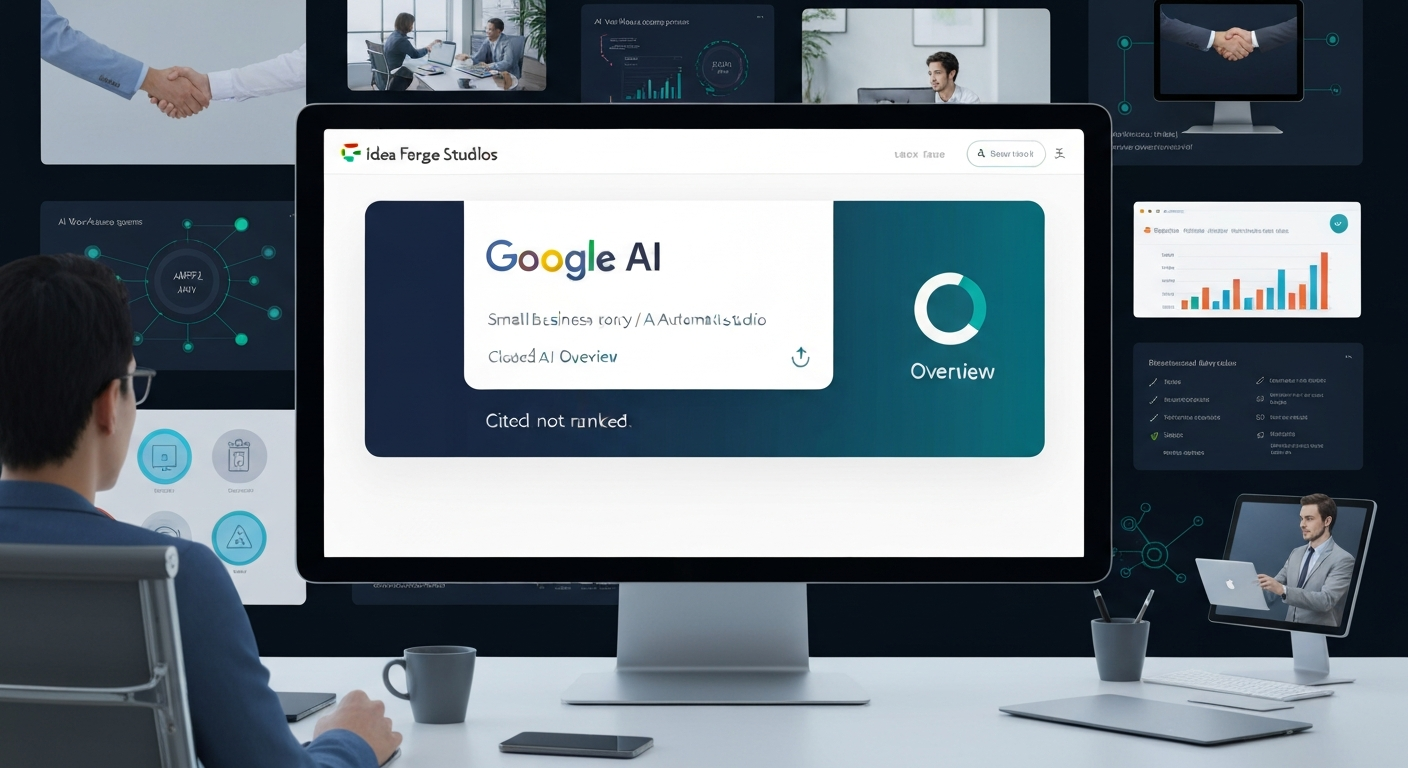
Google says no special schema is needed to appear in AI Overviews. Here's what actually earns a citation, the honest math on shrinking clicks, and three low-effort moves for small business sites.

The Dawn of Next-Gen AI Workflows: A New Era of […]

Beyond Traditional Automation: The Rise of AI in Modern Workflows […]

From Efficiency to Innovation: The Imperative of AI-Driven Business Transformation […]

Unlocking Efficiency: The Rise of AI Workflow Automation in 2026 […]

Introduction to Agentic AI: Redefining Enterprise Automation In the dynamic […]

AI-Powered Business Process Automation: The Future of Enterprise Efficiency The […]

Introduction: Navigating the AI Hype to Realize True Value The […]

Introduction: How AI Agents Are Reshaping Modern Business Strategy The […]

Revolutionize Your Business: The Power of AI Workflow Automation In […]

The Strategic Imperative of AI in Business Processes In today’s […]

The Dawn of Intelligent Automation with AI Agents The business […]

Boost Your Business: The Era of AI Workflow Automation The […]

The Strategic Imperative: Why AI Workflow Automation Matters Now In […]

Unlocking the Future: How AI Agentic Workflows for Enterprise Transformation […]

The New Horizon: Why AI is Reshaping Content Strategy The […]
Forged Sites are custom-built, static-first websites with a full AI content engine on board — no CMS to log into, no plugins to break, no builder to fight.