






Custom AI Solutions: When a Canvas Is Not Enough

Keep the canvas until four tests fail
Keep n8n or Make as the default for known sequences. Buy custom AI solutions when the work needs versioned policy, an audit trail that still exists after someone edits or prunes the canvas, multi-system writes that cannot run twice, or data that must not sit in a third-party automation host. That line is an operations test, not a brand preference, and it tracks how public guidance treats documentation, traceability, and record retention [1][2].
Visual canvases are the right default for known sequences
A visual workflow tool earns its keep when the path is already decided: a webhook arrives, fields are mapped, a notification goes out, a row is appended. The sequence is inspectable on a board. That is why we still start most automation work on a canvas.
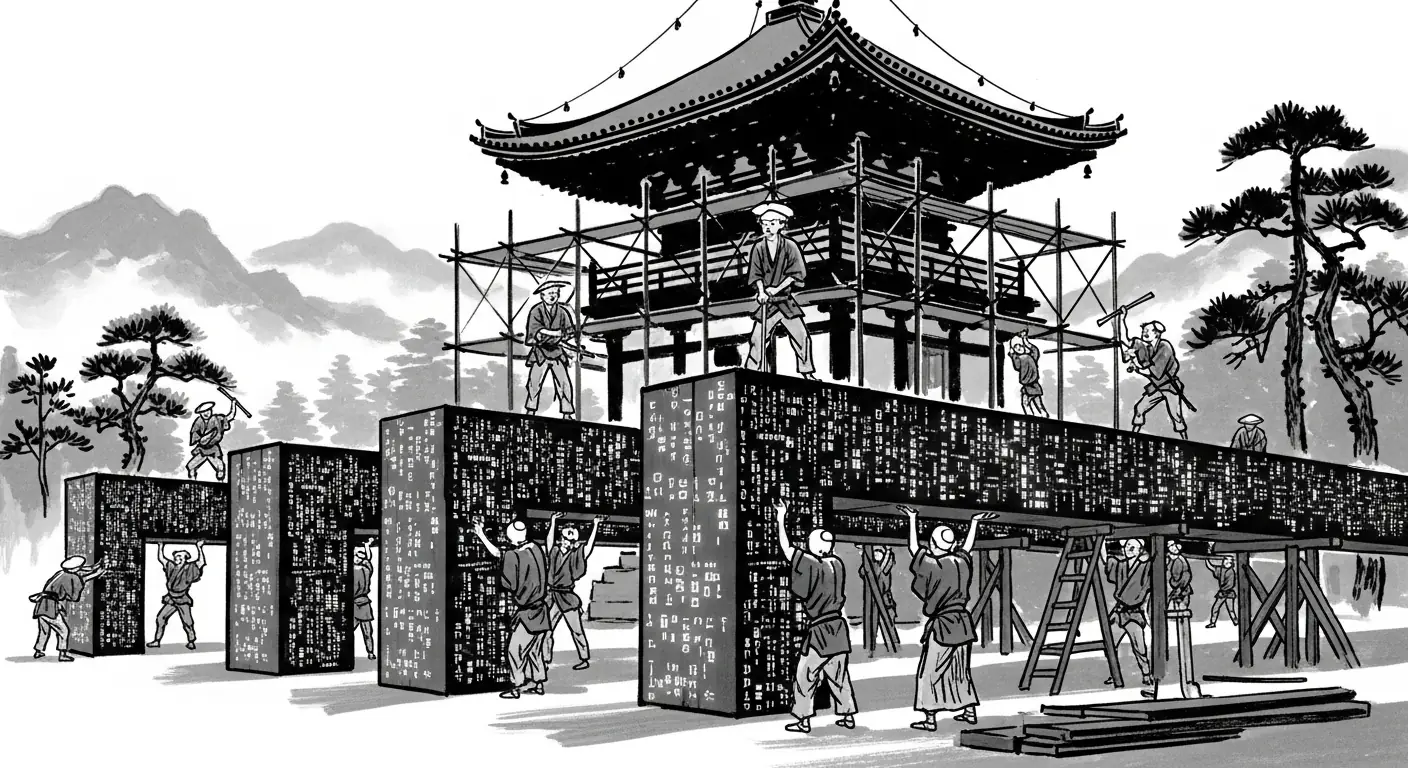
The canvas stops being enough when the diagram is asked to be three other things at once: the policy, the system of record, and the write coordinator. Policy has to be named and attributable. Records have to outlive the last person who saved the scenario. Writes across billing, inventory, and a customer system have to survive retries without creating a second invoice. That is a statement about what a visual runner is built to do, not a criticism of n8n or Make.
The NIST AI Risk Management Framework (AI RMF 1.0, January 2023) treats governance as a cross-cutting function. It calls for policies, processes, and documentation that connect technical design to organizational values, and it includes legal issues around third-party software, hardware, and data [1]. The OECD AI accountability principle, updated in 2024, asks AI actors to ensure traceability of datasets, processes, and decisions so outputs can be analyzed and inquiries answered [2]. ISO/IEC 42001:2023, published in December 2023, is the international management-system standard for organizations that provide or use products or services that utilize AI [3]. A management system lives in named policy, assigned roles, and retained records. It does not live in a node comment on a shared scenario.
Test 1: Can you version the policy, not just the diagram?
Ask who can change the rule that decides an outcome, and how you would prove which rule was in force last Tuesday. If the answer is "whoever has editor access, and the proof is the current drawing," you do not have versioned policy. You have a living sketch.
Make's documentation is clear about the difference. Version history lets a team restore previously saved scenario versions for up to 60 days, and it is a recovery aid for broken mappings, accidental deletes, and overlapping edits [6]. That is useful. It is not a policy register. Restoring a drawing does not tell an auditor which threshold, allow-list, or model instruction produced a given customer decision.
n8n makes a similar split on the execution side. Cloud instances prune execution logs by age and by count, and instances you run yourself default to deleting execution data after 336 hours (14 days) unless you change `EXECUTIONS_DATA_MAX_AGE` [4][5]. Run history is operational telemetry, not a policy archive.
Custom AI solutions put the decision rule in a service you own. The canvas still calls that service. The service returns allow, deny, or escalate, and it records the policy identifier with the decision. NIST's Govern function is explicit that documentation improves transparency, human review, and accountability [1]. That documentation has to sit somewhere a canvas edit cannot silently replace. If you cannot name the policy version on a sample of last month's decisions, this test has already failed.
Test 2: Will the audit trail survive a canvas change, a prune, or a deleted workflow?
Debugging a failed run and answering a records request are different jobs. Canvas history is built for the first. Retention policy is built for the second.
On n8n Cloud, automatic pruning removes execution logs after 7 days on Starter (capped at 2,500 saved executions) and after 30 days on Pro (capped at 25,000), whichever limit is hit first [4]. n8n that you run yourself prunes on a rolling basis by default, with a 336-hour age cutoff and a 10,000-execution cap unless you raise them [5]. Make stores scenario run history for a number of days that depends on the subscription tier, and it lets you export a CSV of run metadata [7]. Those windows keep databases from filling up. They are the wrong windows if a dispute, an insurance claim, or a regulator can arrive six months later.
The EU AI Act is not a blanket rule for every internal automation. Where a system is high-risk under that regulation, the bar is not a 7-day debug log. Article 12 requires high-risk systems to support automatic recording of events over the lifetime of the system [8]. Article 19 then requires providers to keep those logs, to the extent they are under their control, for a period appropriate to the intended purpose and of at least six months unless other law says otherwise [9]. You do not need to be in scope of that regulation to notice the gap: a canvas that forgets successful runs after a week cannot reconstruct last quarter.
NIST SP 800-53 Revision 5 (published 2020, with later updates) includes control AU-11, Audit Record Retention. Organizations retain audit records for an organization-defined period consistent with records policy, to support after-the-fact investigations and to meet regulatory and organizational retention requirements, including legal process [11]. If your retention number is measured in months or years, the canvas is a producer of events, not the store of record.
A second failure mode is quieter than pruning. Someone deletes a workflow or restores an older drawing. The current canvas no longer matches the path that ran in March. Custom AI solutions write an append-only decision log (who, what, which policy version, which downstream systems) to storage you control. The canvas can change on Monday. March is still queryable. If you cannot replay last quarter's material decisions without trusting the current diagram, this test has failed.
Test 3: Do writes span systems that cannot tolerate a double apply?
Known sequences often write to one system. Trouble starts when one trigger must create or update records in two or three systems of record, and a retry is possible.
HTTP is explicit about why this matters. RFC 9110 (June 2022) defines a method as idempotent when the intended effect on the server of multiple identical requests is the same as the effect of a single request. PUT, DELETE, and safe methods are idempotent under that specification. POST is not. The RFC warns that a client should not automatically retry a non-idempotent method unless it can know the semantics are actually idempotent or can detect that the original request was never applied [10]. Canvas runners retry. Networks drop. Webhooks fire twice. A human clicks retry. If your scenario POSTs a charge, then a shipment, then a CRM note, a second pass is not the same run. It is a second charge.
Visual tools can check a status field before writing. In practice that check lives in a function node that someone will edit or copy incorrectly. Custom AI solutions treat the multi-system write as a single unit of work with a caller-supplied request identifier. The service records the identifier before it touches billing or inventory. A duplicate delivery returns the original result. Adding more modules does not create a transaction boundary across vendors. A coordinator you own does. If a double fire would create money movement, inventory movement, or a customer-visible record you cannot cheaply reverse, this test has failed.
Test 4: Must the payload stay out of a third-party automation host?
Every vendor-run canvas is a third party in the data path. Credentials, payloads, and execution contents pass through that environment so the runner can map fields and call the next API. For many internal sequences that is acceptable, and both n8n and Make document controls for what they store and for how long [4][7]. The test is whether your data classification, contracts, or customers allow that pass-through at all.
NIST's Govern function includes third-party software, hardware, and data in the lifecycle the organization has to manage [1]. OECD accountability includes traceability of datasets, not only of the final decision [2]. If the payload is health information, payment details, personnel files, or unpublished operational data, a vendor-run iPaaS in the path is a fact you may have to explain. Running n8n on infrastructure you control moves the environment, which solves some of this and none of tests 1 through 3 by itself. That canvas still prunes, still retries, and still stores policy as a drawing unless you design otherwise [5].
Custom AI solutions keep the sensitive write path on a service that talks to your systems of record. The canvas can still orchestrate the harmless steps. The record, the model input, and the decision stay off the shared automation environment. If you would not paste the payload into a vendor's debug view, this test has failed.
How to split the work without throwing away the canvas
The practical pattern is not "rip out n8n." It is "stop asking n8n or Make to be the policy engine, the audit store, and the write coordinator."
Keep the canvas for intake, notifications, and sequences that write to one forgiving system. Point the material step at a custom service that owns four artifacts: a versioned policy document, a decision API, an append-only audit log with retention you set, and an idempotent write path into the systems that cannot tolerate duplicates. The canvas remains the visible operations layer.
ISO/IEC 42001 is useful as a design prompt even if you never seek certification. It asks the organization that provides or uses AI-based products or services to establish, implement, maintain, and continually improve an AI management system [3]. A management system is policies plus evidence. The canvas can trigger work. It cannot be the management system.
When we scope custom AI solutions with operations leaders in Charlotte, Raleigh, Asheville, or Philadelphia, we start with a sample of real runs. We pick one workflow that already exists on a canvas, run the four tests, and only then decide what to extract. If all four tests pass, we leave it on the canvas. If two or more fail, we extract the decision and the writes.
Practical takeaways
- Default to the canvas for known, single-system sequences. Buy custom AI solutions only where a test fails.
- Version the policy in a store the diagram cannot overwrite. A 60-day scenario restore is recovery, not a policy register [6].
- Treat canvas execution history as debug telemetry. n8n Cloud Starter retains execution logs for 7 days (2,500-run cap) and Pro for 30 days (25,000-run cap) [4]. n8n you run yourself defaults to a 14-day age cutoff [5].
- If you need months of reconstructable history, write an append-only log you control. High-risk systems under the EU AI Act must support lifetime event recording and at least six months of provider-held logs where those logs are under the provider's control [8][9]. NIST AU-11 treats retention as an organization-defined records decision [11].
- If one trigger writes to two or more systems of record, require an idempotent coordinator. RFC 9110 treats POST as non-idempotent and cautions against blind retries [10].
- If the payload must not sit in a vendor-run iPaaS, keep the sensitive path on a service you own [1][4].
- Re-run the four tests when the workflow starts writing to a new system or a contract adds a retention clause.
How we can help
Have more questions or want to get in touch? Our team will run the four tests on a live workflow and tell you what should stay on the canvas and what should move into custom AI solutions. Start on our contact page, call (980) 322-4500, or email [email protected]. You can also review how we approach AI tools for operations before we talk.
Citations
- NIST AIRC, "5 AI RMF Core" (2023)
- OECD.AI, "Accountability (Principle 1.5)" (2024)
- IEC Webstore, "ISO/IEC 42001:2023, Information technology - Artificial intelligence - Management system" (2023-12-18)
- n8n Docs, "Manage your data" (2026)
- n8n Docs, "Executions" environment variables (2026)
- Make Help Center, "Restore and recover scenario" (2026)
- Make Help Center, "Scenario history" (2026)
- European Commission AI Act Service Desk, "Article 12: Record-keeping" (Regulation (EU) 2024/1689)
- European Commission AI Act Service Desk, "Article 19: Automatically generated logs" (Regulation (EU) 2024/1689)
- IETF RFC 9110, "HTTP Semantics, Section 9.2.2, Idempotent Methods" (2022-06)
- NIST, "SP 800-53 Revision 5, Security and Privacy Controls for Information Systems and Organizations, AU-11 Audit Record Retention" (2020)