






How to Get Your Small Business Cited in Google AI Overviews (Not Just Ranked)
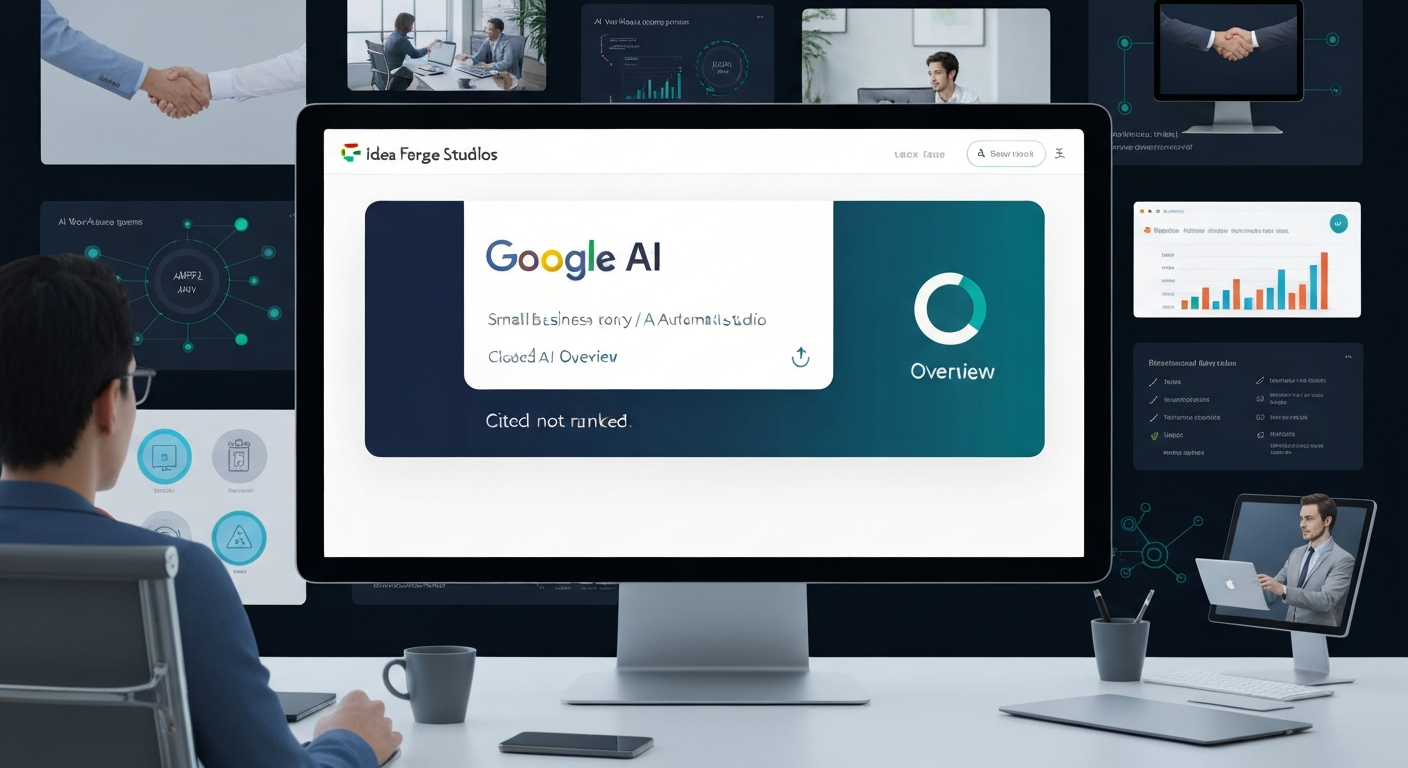
The bottom line: how to get your small business cited in Google AI Overviews
If you want to get your small business cited in Google AI Overviews, the fastest path is not a schema plugin. Google's own documentation says there is no special markup required to show up in AI Overviews or AI Mode. What actually earns a citation is the same thing that has always earned trust: content that answers a specific question clearly, structured data that accurately describes what is already on the page, and a site that is easy for both people and machines to read. The businesses winning citations right now are not the ones chasing a hack. They are the ones treating AI visibility as a natural extension of doing SEO fundamentals well.
Why this is urgent now, not eventually
AI-generated answers are no longer a side experiment inside Search. At Google I/O 2026, Google reported that AI Mode has surpassed one billion monthly active users, with query volume more than doubling every quarter since launch. In the same keynote, Google disclosed that AI Overviews now reaches over 2.5 billion monthly active users, alongside token-processing volume that has grown roughly sevenfold in a year.
For a small business, that scale means a growing share of the people searching for what you do are reading an AI-generated summary before they ever see a traditional list of blue links. Whether your business is named in that summary is quickly becoming as important as where you rank underneath it.
The pie is shrinking. Being cited decides your slice.
It would be dishonest to pitch AI search as free upside. A Seer Interactive study covering 3,119 informational queries across 42 organizations, reported by Search Engine Land, found that once an AI Overview appears on a search result, average organic and paid click-through rates both fall sharply.
| Metric | Before AI Overview | After AI Overview | Relative change |
|---|---|---|---|
| Organic CTR | 1.76% | 0.61% | -61% |
| Paid CTR | 19.7% | 6.34% | -68% |
An independent Ahrefs analysis of 300,000 keywords corroborates the direction of that finding, measuring a 58% reduction in click-through rate for top-ranking pages once an AI Overview is present, up from a 34.5% reduction it measured a year earlier. Three independent firms now converge on the same range. The overall pie of organic clicks is smaller than it used to be.
But the same Seer Interactive study found the opposite is true for businesses that get cited by name inside the AI Overview itself.
| Metric | Cited brands, vs. non-cited |
|---|---|
| Organic clicks | +35% more |
| Paid clicks | +91% more |
That is the actual pitch for AI visibility, and it is a more honest one than "AI search sends you free traffic." The pie is shrinking. Being cited is what determines the size of your slice of it.
Forget the schema magic bullet. Here is what Google actually says.
A lot of AEO advice circulating right now leans on the idea that adding FAQ schema or other structured markup is the single highest-leverage move you can make to get cited. Google's own Search Central documentation on AI features says otherwise: there are no additional requirements or special optimizations necessary to appear in AI Overviews or AI Mode, and no special schema.org structured data that needs to be added. Google's guidance instead points back to the fundamentals, indexability, quality content, and a good page experience.
That does not mean structured data is worthless. Google's own page notes that if you already use structured data, it should accurately match the visible text on the page. Treat it as hygiene, a way of confirming what a page already says clearly, not as a shortcut that substitutes for having something worth citing in the first place. If your on-page content does not answer a real question in plain language near the top of the page, no amount of markup underneath it will fix that.
Ranking well and getting cited are not the same game
A Semrush comparison study found that Google's AI Mode shows only about 35% URL overlap with Google's own top-10 organic results, compared with roughly 67% overlap for AI Overviews and over 82% for Perplexity. AI Mode also tends to cite a wider spread of domains per response, an average of about seven unique sources, and routinely pulls in pages ranking beyond position 21 in classic search.
The practical takeaway is that a page ranking on page one does not automatically get pulled into an AI answer, and a page that would never crack the top ten in a classic search result can still get cited if it answers the specific question clearly. Ranking and citation are correlated, but they are measurably different games with different rules. This is the distinction we lean on in our own SEO work: optimizing for a rank position and optimizing for a citation are related goals that call for somewhat different priorities.
Three things you can actually do this quarter
- Answer the question directly, near the top of the page. Before you write anything else, state the direct answer to the question your page is targeting in the first paragraph or two, in plain language. AI systems extract summarizable answers; a page that buries its point three sections down under a long introduction is harder to lift into a citation.
- Keep structured data accurate, not decorative. If you already use schema markup, audit it against what actually appears on the page. Per Google's own guidance, accuracy is what matters, not the presence of markup for its own sake.
- Give people a reason to prefer you directly. Google has rolled out a feature called Preferred Sources, letting users pin favorite sites for prioritized visibility across regular search, AI Overviews, and AI Mode. Google states people are about twice as likely to click through to a source they've marked as preferred. A visible, one-click prompt inviting repeat visitors to add your site as a preferred source is a low-effort way to build the kind of direct-visit signal that benefits you well beyond any single search result.
None of this requires ripping out your existing SEO work and starting over. It is the same discipline, aimed at a slightly different target: not just where you rank, but whether you get named.
If you want a second opinion on where your site currently stands with AI-driven search, or help auditing your structured data and on-page answers, contact our team and we'll walk through it with you.
Citations
- Google Search's I/O 2026 updates: AI agents and more — Google (2026-05-19)
- Google I/O 2026: Sundar Pichai's opening keynote — Google (2026-05-19)
- Google AI Overviews drive 61% drop in organic CTR, 68% in paid — Search Engine Land, reporting a Seer Interactive study (2025-11-04)
- Update: AI Overviews Reduce Clicks by 58% — Ahrefs (2026-02-04)
- AI Features and Your Website — Google Search Central (2025-12-10)
- How Google's AI Mode Compares to Traditional Search and Other LLMs — Semrush (2025-07-21)
- Google brings Preferred Sources to AI Overviews and AI Mode — Semrush (2026-06-01)